
MDOC Releases Serving Dickinson County
The Michigan Department of Corrections operates state prisons and community supervision across Michigan. No MDOC prison was identified in Dickinson County. A person sentenced from Dickinson County may enter an institution elsewhere, later leave prison on parole, report to a field office, or complete the sentence through discharge. That statewide path is different from a short county-jail stay. A transfer from Dickinson County Correctional Center to MDOC ends county custody but does not release the person from confinement.
The record must be read in stages. OTIS identifies current MDOC status and sentence information. A parole order supports release from prison into supervision. A discharge document proves the MDOC sentence or parole term ended. The Dickinson sentencing court can resolve errors rooted in the Judgment of Sentence. When supervision is local, the Dickinson County Parole/Probation Office is the direct route for a status question or a correction tied to supervision.
Search MDOC Release Status in OTIS
The official OTIS page explains the public Michigan offender search. Its scope includes prisoners, parolees, probationers, interstate-compact cases, escapees, and absconders who are or were under MDOC jurisdiction. It does not cover every Michigan arrest or a Dickinson County jail-only sentence. A blank OTIS search therefore does not prove that a person was never held locally or released from the county jail.
Use an MDOC number when it is known. A number points to one state record and avoids many namesake errors. Otherwise, search a full name and compare age, sex, race, physical description, aliases, identifying marks, sentencing county, court, and offenses. Open the profile only after those facts align. Status and location come before dates because an Earliest Release Date means something different for a prisoner, parolee, or probationer.
- Open OTIS, continue to the application, and accept its terms.
- Enter the MDOC number, or search by name with available narrowing details.
- Match identity, sentencing county, court, and offense information.
- Read current status and location before reviewing sentence dates.
- Compare Date Paroled, Earliest Release Date, Maximum Discharge Date, and discharge information without merging their meanings.
- Confirm the result with MDOC, the sentencing court, the field office, or a formal release document.
MDOC Release Fields and Meanings
An OTIS profile can include a photograph, name, MDOC number, status, location, physical description, aliases, sentence blocks, sentencing court, offense information, and release-related dates. Photos are not available for every historical person. A state corrections photo is also not the same thing as a Dickinson County booking photograph. Each field must stay within its actual purpose.
Multiple sentences can run at the same time or one after another. They may show different dates. Reading one row in isolation can produce a false answer, especially when the profile still lists prison or parole as the active status.
| OTIS field | What it establishes | Key limit |
|---|---|---|
| Status and location | Current reported MDOC relationship | Verify if the record may be stale |
| Earliest Release Date | First parole-eligibility point under the applicable sentence rules | Not an actual release promise |
| Date Paroled | Reported movement from prison to parole | Supervision continues |
| Maximum Discharge Date | Potential endpoint of the controlling state sentence | Can be lawfully recalculated before discharge |
| Discharge information | Reported end of the MDOC relationship | Formal proof comes from the discharge instrument |
| Probation status | Court-ordered community supervision tracked by MDOC | Does not alone prove prior prison custody |
Official MDOC Release Search Screen
The OTIS application and terms provide the correct statewide entry point for a Dickinson County-related state sentence.
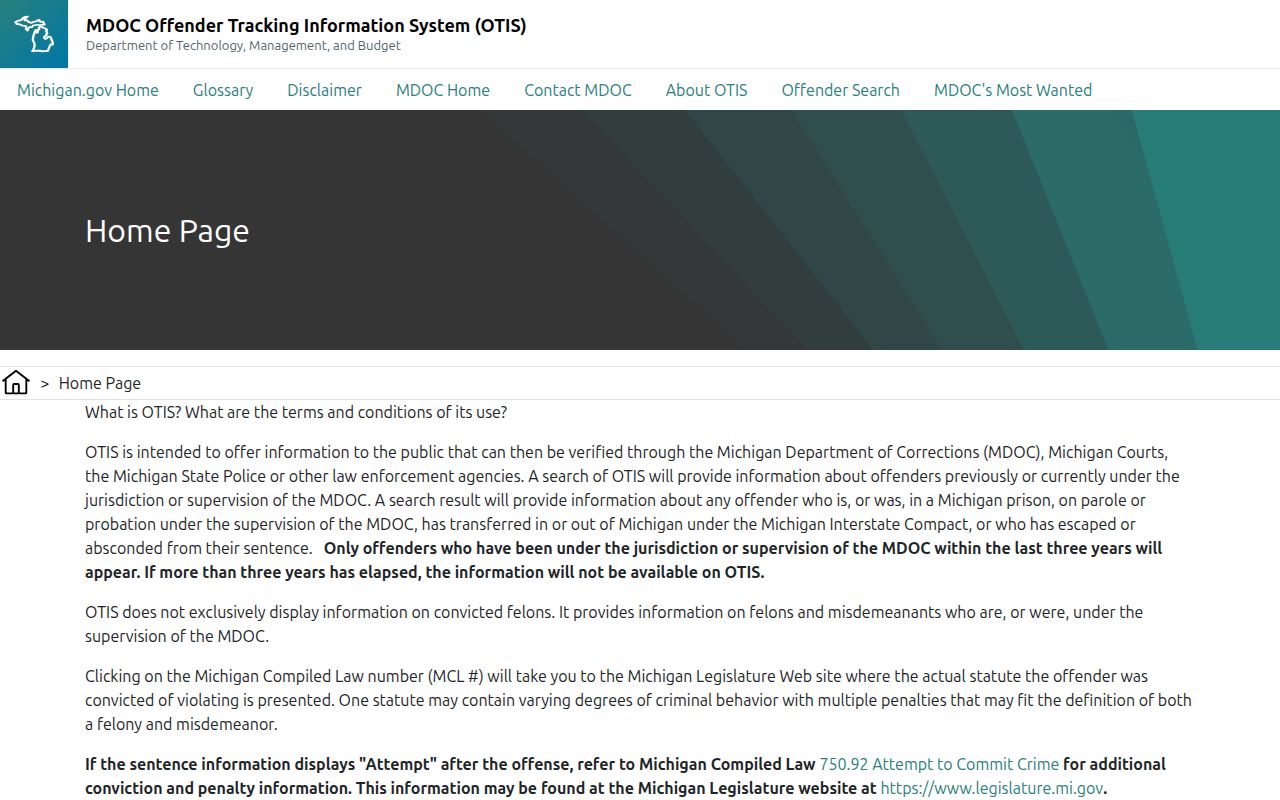
The search screen leads to profiles that must be matched by identity and sentencing facts. It cannot substitute for a county release record when the person served only local jail time.
MDOC Parole Versus Final Discharge
Parole is conditional release from prison into MDOC community supervision. The Michigan Parole Board is the paroling authority for felony prisoners committed to MDOC. A grant authorizes conditional release after arrangements and required notices. It does not necessarily identify the moment someone walks out. A deny sets a future review point, while a defer postpones final disposition. Routine individual decisions are not supplied through a public searchable decision database.
Discharge is a later and different event. MDOC Policy Directive 03.01.135 identifies the Certificate of Discharge/Sentence Termination/Sentence Discharge by Court Order, form CSJ-130, for maximum or court-ordered discharge. Successful completion of parole uses the Parole Board Order for Discharge from Sentence, form CAX-115. A court probation-discharge order is separate. Naming the needed instrument produces a clearer records request than asking MDOC for every file.
- Parole
- Release from state prison while MDOC control continues in the community.
- Probation
- Court-ordered community supervision that may not follow prison.
- Discharge
- The formal end of the relevant state sentence or supervision.
- Absconder
- A reported loss of contact or noncompliance during supervision, not proof of present confinement.
Michigan Prison Release Date Rules
Michigan is not correctly described as a system where every prisoner serves about 85 percent of a sentence. For modern truth-in-sentencing cases, the person generally must serve the full judicial minimum before parole eligibility. MCL 791.233b supplies the truth-in-sentencing framework, while MCL 791.234 governs Parole Board jurisdiction and special sentence rules. Older offense dates and sentence types may involve legacy good time or disciplinary credits under different statutes.
Earliest Release Date is the public OTIS label for eligibility. It is not a scheduled door-out date. Maximum Discharge Date is a potential endpoint. Detainers, sentence corrections, consecutive terms, credit changes, court orders, and parole decisions can change the practical result. For an MDOC prisoner whose maximum discharge falls on a weekend or state holiday, the policy calls for discharge on that actual date, although administrative work can occur earlier. A detainer can still send the person directly to another agency.
County jail good time must remain separate from this state-prison calculation. Michigan’s County Jail Good Time Act applies its own framework to qualifying local sentences, and OTIS does not calculate a Dickinson County jail release. For a person who moved from the county correctional center into MDOC, identify the transfer date first, then apply the state record only to the later prison term. Mixing the two systems can turn county sentence credit into a false state release estimate.
| Date or event | Effect on the release question |
|---|---|
| Earliest Release Date | Begins potential parole eligibility, not guaranteed release |
| Parole grant | Authorizes conditional release after processing and required arrangements |
| Detainer | Can turn MDOC discharge into transfer to another custodian |
| Maximum discharge | Ends the controlling term after valid calculations |
| Court correction | Can change sentence data used by MDOC |
MDOC Release Records and Corrections
Choose the contact by the source of the issue. If OTIS conflicts with a Judgment of Sentence, begin with the sentencing court. MDOC updates court-derived data when directed through the proper order. A supervision or absconder-status issue goes to the supervising office. Formal completion proof should identify the CSJ-130 certificate or CAX-115 parole-discharge order. The Dickinson County released inmate search covers the separate county-jail record and court path.
The official Region 1 directory lists the Dickinson County Parole/Probation Office at the county government complex. No walk-in hours or local check-in procedure were published, so call before going. That office verifies local supervision, not confinement at a prison within Dickinson County.
Dickinson County Parole/Probation Office300 East D Street
PO Box 609
Iron Mountain, MI 49801
906-774-1446
Walk-in hours not published
The Michigan Parole Board can be reached at 517-373-0270 or Parole-Board-Staff@michigan.gov, Monday through Friday, 8 a.m. to 5 p.m. Those details apply to the Board, not to every prison or field office.
MDOC Discharge Search Retention
OTIS keeps discharged profiles visible for only three years after discharge from supervision. It can also remove a qualifying record after set-aside or expungement. The absence of a name after those limits does not show that the person was never under MDOC control. Historical proof may require the sentencing court, MDOC records, or a retained discharge document.
MI-VINE can supply a release, transfer, or other custody-event alert for participating reporting agencies, but it is not a permanent discharge certificate. Likewise, an OTIS screenshot is useful corroboration but not the signed instrument that ends the sentence. The strongest Dickinson County result pairs state status with the proper order or certificate and checks for any receiving custodian.
An OTIS error also has to be routed by source. Court and sentence facts begin with the court that entered the judgment. A local parole, probation, or absconder notation begins with the supervising office. MDOC updates the public system after the authorized court or agent supplies the correction, so sending the same broad complaint to several offices can delay the specific record fix.
Note: A Dickinson County jail departure into MDOC is a transfer, while MDOC parole is release from prison into continuing supervision.