
BOP Releases Serving Dickinson County
The Federal Bureau of Prisons holds people serving federal sentences. No federal prison was identified in Dickinson County. A person tied to the county may be sentenced in federal court and housed elsewhere, or may leave a local or contract jail before commitment to BOP. Those stages belong to different custodians. The U.S. Marshals Service generally controls federal pretrial prisoners, while BOP becomes the sentenced-custody source after commitment.
A BOP result applies only to BOP custody. “Released” or “Not in BOP Custody” means BOP is no longer holding the person. It does not guarantee return to the community. Another correctional or law-enforcement body may receive the person, and federal supervised release may begin after confinement. The correct result names both the end of BOP custody and any known next custodian or supervision route.
Search BOP Release Status
The BOP Inmate Locator covers federal inmates from 1982 forward. A known identifying number offers the clearest route. The locator accepts BOP register, FBI, DCDC, or INS numbers. A name search can use optional age, race, and sex details. Those fields help distinguish people with similar names, but the matching federal case and sentence should still be checked.
Results can show name, register number, age, race, sex, release date, and location or status. Read the complete row. A future release date is not a guarantee because sentence calculations can change. BOP specifically notes that First Step Act calculations may affect displayed dates, so a result should be checked again near the expected event.
- Search by a known federal identifier whenever possible.
- If using a name, add available age, race, and sex details.
- Match the register number and identity to the correct federal case.
- Read both the release date and location or status field.
- Check whether the result says released, not in BOP custody, or identifies a current institution.
- Confirm the release method, supervision, and any receiving agency through the federal record.
Federal Release Locator Screen
The official BOP search screen is the proper locator for federal sentenced custody connected to Dickinson County.
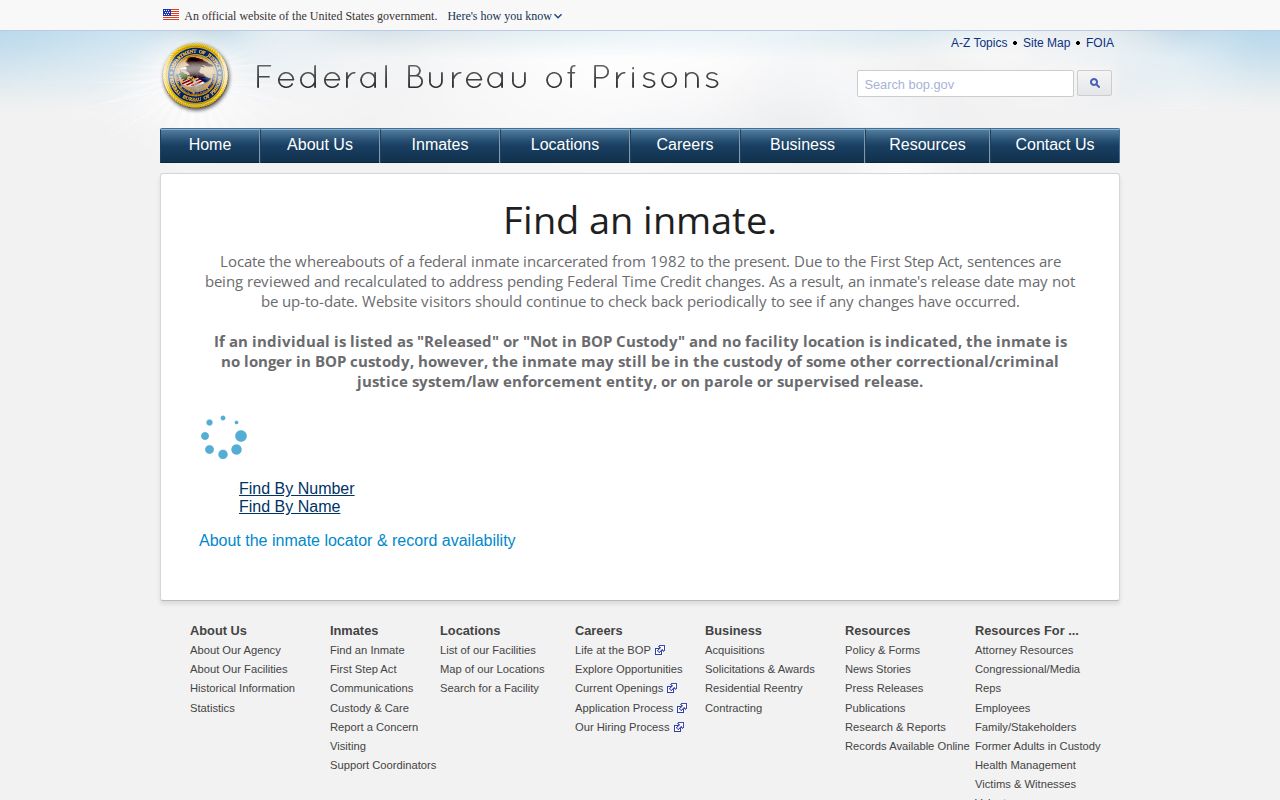
The displayed status should be paired with the federal docket or release paperwork when the destination, release method, or supervision terms matter.
BOP Release Record Fields
The locator is a status tool, not the whole federal release record. It can identify the person and display a date, yet it may not explain whether BOP released the person to the community or delivered the person to another authority. The Notice of Release and Arrival form shows the additional facts that make the outcome clear.
That form distinguishes community release from release to a detainer. It can include the release date and method, institution, detaining agency, transportation and arrival details, supervision jurisdiction and contact, proposed residence, and reporting directions. The form’s structure explains why “released” should not be translated automatically into a community return.
| Federal field | What it answers |
|---|---|
| Name and register number | Which BOP record belongs to the person |
| Release date | The reported or projected end of BOP custody |
| Location or status | Whether BOP reports current custody or release |
| Release method | How the institution processed departure |
| Community or detainer | Whether the person left for the community or another custodian |
| Detaining agency | Who may hold the person next |
| Supervision jurisdiction | Which federal supervision office may receive the person |
Federal Release Detainers and Transfers
A detainer preserves another agency’s claim to custody when BOP confinement ends. The receiving agency may be a state corrections department, county jail, U.S. Marshals authority, or immigration agency. A person can therefore have a valid BOP release date and remain confined elsewhere the same day. The BOP record is not wrong in that situation; its statement ends at the edge of BOP control.
For a Dickinson County-related person, trace the receiving agency named on the release document. A transfer to Michigan custody calls for OTIS or the responsible jail. An immigration transfer calls for the ICE locator and its field-office route. A court-ordered federal transfer or unresolved federal proceeding calls for the docket and the facility actually holding the person. The Dickinson County release search explains how county, state, federal, and immigration sources fit together.
- Released
- BOP reports that its custody ended.
- Not in BOP Custody
- BOP does not currently hold the person, though another agency may.
- Detainer
- A basis for another authority to receive the person after BOP.
- Supervised release
- Federal court supervision after confinement, separate from BOP physical custody.
BOP Versus Marshals Custody
BOP Locator is often the wrong first source for a federal pretrial detainee. The U.S. Marshals Service controls many people detained under federal court orders before acquittal, release, or commitment to BOP. Most are held in contracted state, local, or private facilities. A person may occupy a jail bed while the legal custodian is federal.
There is no public historical USMS person locator comparable to BOP’s search. Before BOP commitment, use the federal court docket to find detention or release orders and identify the actual holding facility. Contact that facility for current operational status within its disclosure limits. After a federal sentence and commitment to BOP, use the BOP register number and locator. This handoff prevents a blank BOP search from being treated as proof of release.
| Custody stage | Primary source | Release confirmation |
|---|---|---|
| Federal pretrial detention | Federal docket, USMS, actual facility | Court release order plus facility departure |
| Federal sentenced custody | BOP Locator | BOP status and release record |
| Release to detainer | BOP release form and receiving agency | Departure plus new custody record |
| Community release | BOP release record and federal supervision source | Release method and supervision details |
BOP Release Date Changes
A date in the locator can change before departure. BOP warns that First Step Act calculations may alter displayed dates. Court action, sentence computation, earned credits, and other lawful changes may also affect the result. Treat a future date as a current official projection, not as a fixed appointment or proof that release has occurred.
Near the listed date, repeat the locator search and compare the federal docket. After the event, look for a released status and obtain the release document if the destination matters. If a detainer is listed, continue with that agency. If the person is no longer in BOP results but no release proof appears, verify the register number and contact the responsible federal source rather than relying on absence.
A namesake can also create a false timeline. Match the register number, age, race, sex, and federal case before comparing dates. BOP results cover federal inmates from 1982 forward, so an older federal custody claim may need a different archival records route. The locator’s date range and fields define what the public screen can prove; they should not be stretched into a complete account of every federal detention.
BOP Release Records and Verification
The strongest federal release finding combines the locator with a record that states the release method. The BOP Notice of Release and Arrival form is especially useful because it separates community departure from detainer delivery. The federal docket can add the legal basis for release or continuing supervision. Neither a Dickinson County jail record nor Michigan OTIS can replace the federal record for a BOP sentence.
No federal prison or BOP facility address was identified in Dickinson County, so a local prison contact card would be false. Use the statewide federal locator first, then the institution or office named in the federal record. If the search instead reveals pretrial USMS custody, change paths. If it reveals Michigan, county, or ICE custody after BOP, confirm with that receiving system.
A precise verification request should identify the person, register number, federal case, institution, and date range. Ask for the existing release or arrival record that states method, destination, detaining agency, and supervision jurisdiction. A locator screenshot is useful for a quick status check, but it cannot supply every field that appears on formal release paperwork. Keeping the request narrow also makes clear that the question concerns one BOP custody transition.
Release to the community can begin a federal supervision term administered outside BOP. That supervision does not return the person to BOP custody, and it should not be confused with Michigan parole or probation. The federal judgment and release paperwork identify the applicable federal route. When a record names a reporting office, confirm with that office instead of using a Dickinson County field office that serves MDOC cases.
Note: A BOP release date answers when federal prison custody ends; the release method answers where the person goes next.